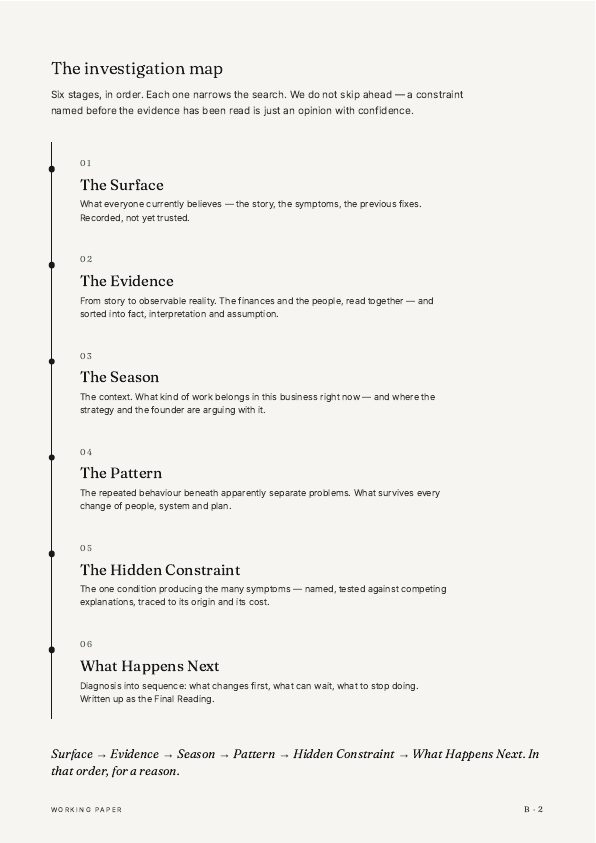
The investigation map
I get inside the working reality of the company and follow what doesn’t add up until the real gap shows itself.
Pick yours. New hires who somehow reproduce the same old problem. Software that was supposed to fix operations but merely created another place to update. Growth that has made the company less coherent. Information trapped in people. Constant rework. Workflows nobody formally designed. A business that functions only because certain people quietly rescue it.
None of these are the problem. They are what the problem produces.
A problem that survives several sincere fixes is almost never what it appears to be.
One invisible gap, quietly producing twenty visible problems.
In most established businesses, the things going wrong are not separate problems. They are symptoms — produced by one gap sitting somewhere deeper, feeding all of them at once.
Fix the symptoms and they return, or reappear somewhere else wearing different clothes.
The gap stays invisible for a simple reason: you are working inside it. It rarely announces itself in a spreadsheet or a board meeting. It lives somewhere more ordinary — the handover everyone works around, the process nobody actually follows, the knowledge in one person’s head.
You have to get close enough to feel the friction.
An immersion in how your business actually works — conducted by someone willing to notice what everyone else has learned to walk around.
I don’t diagnose from the doorway, and I don’t work from the version of the company that appears in meetings. I spend time inside the working reality: the founder, the finances, the leadership, the team, the operations, the workflows, the customers, the systems, the decision-making, the information flow, the existing software, the workarounds, the season the business is in — and the patterns that keep repeating despite previous attempts to fix them.
Pattern recognition gets me asking the right questions quickly. Immersion tells me whether I’m right.
I do not arrive with an answer. That is the point.
Margins, cash conversion, customer concentration, offer economics — and the results that only hold because somebody personally compensates. Numbers don’t perform. They describe mechanisms.
Formal roles versus actual roles. Where decisions really get made, where they stall, what the team protects, what it has learned not to raise — and who is quietly rescuing what.
How work actually moves, versus how it is supposed to. The process that technically exists but nobody follows. The spreadsheet nobody trusts. The thing everyone stopped questioning — usually the most informative thing in the building.
Which season the business is actually in, which one the strategy was designed for, and where they conflict. Plus the pattern that keeps returning — because what keeps returning is evidence.
Immersion first. Then the reading. Then — only then — the shape of the fix.
Tell me what doesn’t add up. A short, honest account of the recurring problem — and what it has already survived. I take a small number of investigations at a time, and fit matters more than order of arrival.
A conversation. Thirty minutes, if I think there’s something here. No pitch and no deck — we both find out whether this is the right instrument for your business, and if yours is larger or more complex than most, I tell you exactly what the immersion needs to be. Nothing is paid until after this.
Before We Begin. Once we’ve both said yes, you complete the client intake workbook — your version of the story, the symptoms, the previous fixes — and share the evidence: the numbers, the roles, the reality. Access is agreed up front, and handled with care.
The immersion. I get inside the working reality of the company — the founder, the people, the meetings, the systems, the way work actually moves. I watch. I ask. I follow what doesn’t add up. This is where the gap starts to show itself.
The reading. The finances and the people, read together — alongside everything the immersion surfaced. The gap is named, then tested against the evidence until it holds.
The Final Reading. The written findings: what you believed was wrong, what is actually happening, why, the season, the gap, what changes first, what should not be touched — and the shape the fix genuinely needs to take. Delivered, then talked through properly.
What happens next. For many businesses, the engagement ends here — and that is a successful outcome. If the gap needs more than clarity to close, the next stage is scoped then, and only then. Nothing further is sold until the investigation has established that something further is actually required.
Sight. In writing — and a sequence you can actually follow.
Every finding is evidence-based, and every recommendation is sequenced. No fifty-point action plan. No more strategy. The real problem, the order — and the permission to stop fixing the wrong things.
The Fix is not only about knowing what to do. It is knowing what to stop doing.
The Final Reading covers
This is not a call and a PDF of thoughts. The Fix runs on a working document system — a client intake, a working paper we complete together, and a written Final Reading you keep. A few pages, as they actually look:
The investigation map
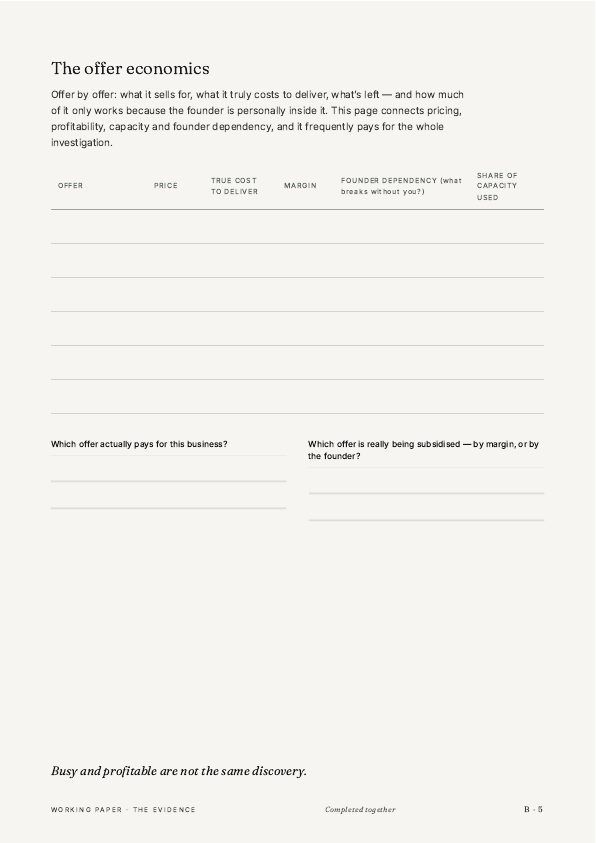
The offer economics
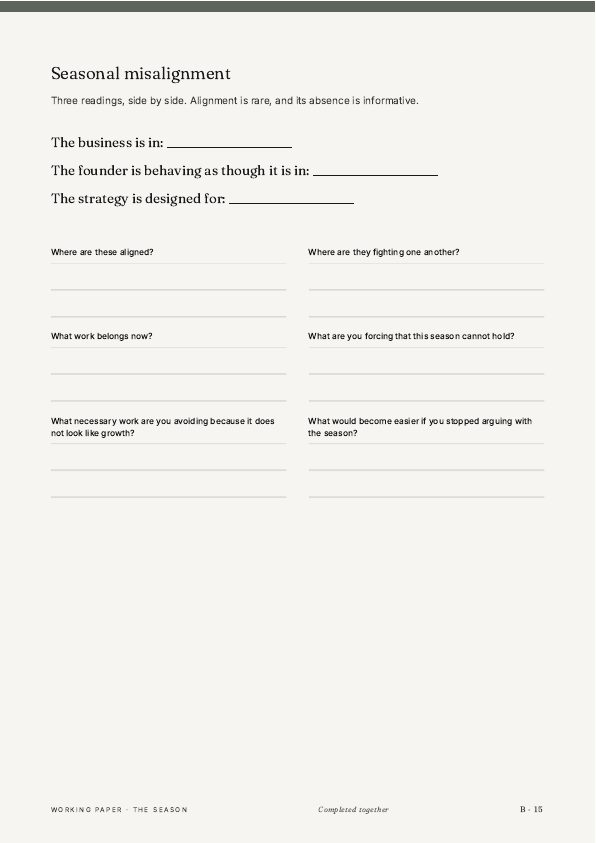
Seasonal misalignment
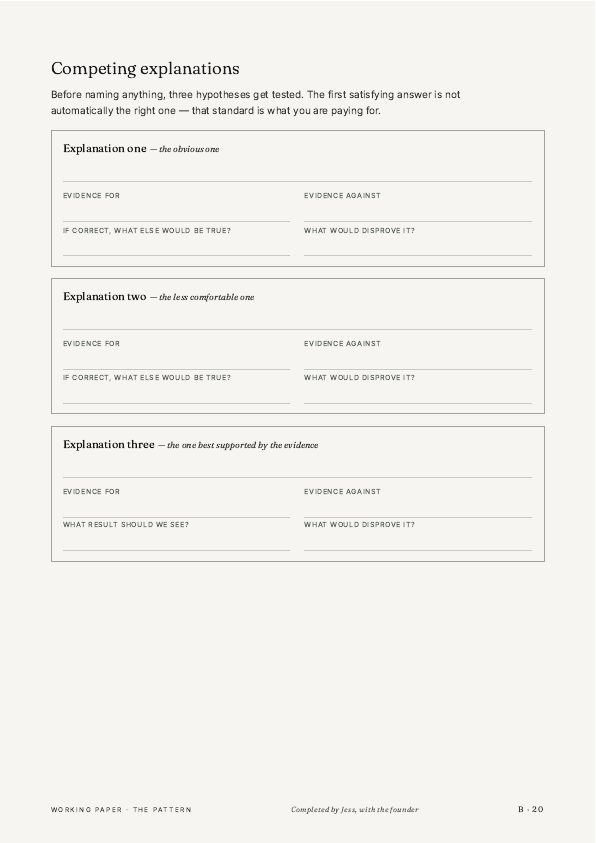
Competing explanations
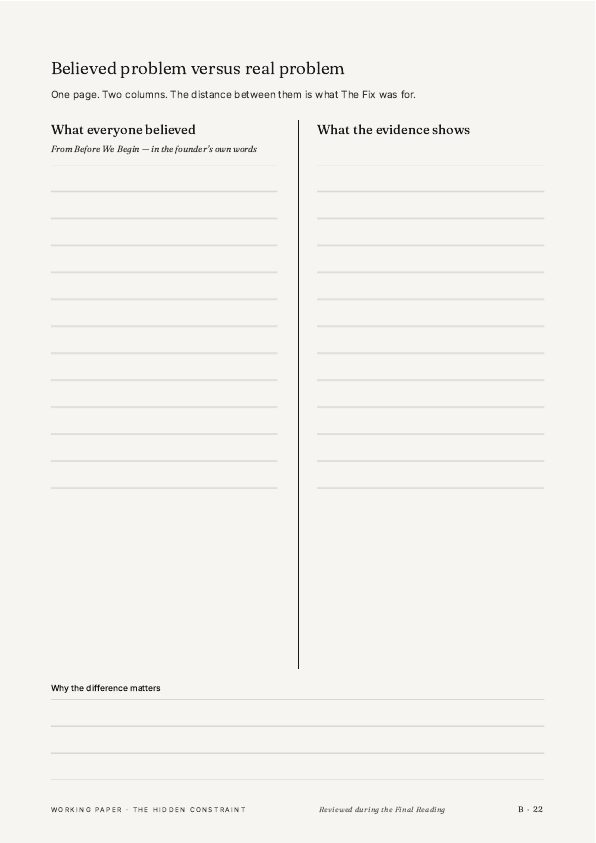
Believed vs real problem
The Final Reading
What happens after The Fix depends entirely on what The Fix reveals. Not a menu. Not packages. A path that becomes visible as understanding deepens.
Immerse & Diagnose — get inside, find the gap. This is The Fix. For many businesses the engagement ends here, with the gap named and the sequence clear. That is a successful outcome, not a stepping stone.
Embed & Fix — change how the business actually works. Sometimes knowing the answer is not enough. The gap may live in roles, ownership, workflow, financial mechanisms, decision rights or operating structure. When that happens, I stay close enough to redesign the relevant part of the business and help the new way of working take hold. Bespoke, and scoped only after The Fix.
Build What’s Missing — only when the thing genuinely does not exist. Occasionally, immersion reveals that the business cannot coordinate or manage itself properly because the infrastructure it genuinely requires does not exist. Only then does Anaptyx build — bespoke, secure, maintainable, owned by you, and designed around how your business actually operates. Most businesses should not reach this stage. That discipline is what makes it credible when one does.
You don’t choose a package. Neither do I.
The business tells us how far the fix needs to go.
Some businesses later keep me as an ongoing thinking partner — major decisions, commercial challenge, problems spotted while they’re still inexpensive. That is a downstream relationship, earned by the work — not a product on a shelf.
If you do not need me afterwards, I will tell you.
They thought they had a sales problem. The gap was operational. Revenue tripled in three months — without a single new campaign.
Nobody asked me to build software. The immersion found that the thing the company genuinely needed did not exist. So Anaptyx built it.
“I’ve learned more about my business in thirty minutes with you than I have in the last five years.” — a founder, on a call that wasn’t even a consultation.
The Fix is for you if
You run an established, founder-led business — real revenue, a team, history, systems, customers, moving parts. Enough complexity for a hidden gap to exist. Something keeps not adding up, it has survived several sincere fixes, and you can give me genuine access — the numbers, the people, the working reality. And you’d rather hear what’s true than what’s comfortable.
It isn’t for you if
You’re early-stage, pre-revenue, or looking for a playbook. You want your current diagnosis confirmed rather than questioned. You can’t share the real numbers, or won’t. Or you’ve arrived asking me to build you software — the build exists because an investigation determined it was the right answer, never the other way round.
Not sure which you are? Take the free seven-minute experience first — Can you see the real problem? →
Because the thing holding a business back rarely announces itself in a spreadsheet or a board meeting. It lives in the working reality — the handover everyone works around, the process nobody actually follows, the decision that quietly waits for one person. Distance is useful for seeing assumptions. Proximity is necessary for seeing reality. I need both.
It won’t find nothing — every business is producing its results reliably, and the evidence always says how. What it may find is that the gap is smaller, or different, or more fixable than you feared. Occasionally the finding is that the business is fundamentally sound and the season is simply being misread. That reading is worth exactly as much as a dramatic one.
Absolutely not. For many businesses the engagement ends with the gap named and the sequence clear — that is a successful outcome, not a truncated one. If the gap needs more than clarity to close, that work is scoped after the investigation, and only if the evidence supports it. If you do not need me afterwards, I will tell you.
Sometimes. But software is never assumed, and it is never the headline. I don’t sell software — sometimes I discover a business needs software. There is a very big difference. The build happens only when immersion establishes that the thing the business genuinely needs does not exist — and whatever gets built is owned by you, with no artificial subscription lock-in.
Expect that assumption to be tested. Sometimes it survives — and then we know it’s real, which is worth more than believing it. More often, the problem you’re describing turns out to be what the actual problem produces. Either way, the investigation follows the evidence, not the existing theory.
Completely. Evidence is shared securely, working papers stay private, and anything published about the work is anonymised beyond recognition. Where I spend time with your team, it’s handled carefully — the immersion is not an inspection, and nobody gets ambushed.
Named here, rather than revealed later. You should be able to decide in your own time, without booking a call to find out what it costs.
That covers the whole investigation: the immersion, the finances and the people read together, the written Final Reading, and the conversation where we go through it properly.
The Fix isn’t the same job in every business. If yours is large or complex enough that the immersion genuinely needs longer, the £5,000 stands as the first stage and I will tell you what the rest looks like before you commit — never after. Nobody discovers the real number halfway through.
Billed in sterling. Overseas clients are charged in sterling at the day’s rate.
Compare it with another year spent solving the wrong problem, exceptionally well.
One question, answered: is there something here worth investigating?
I can’t diagnose your business from a document — and this doesn’t claim to. It’s a first read, in two parts. One call. No deck. Just the eyes.
01 — The read. You send me your numbers and your story. Within 48 hours you get my first read, in writing: the three questions nobody has asked you, where I’d look first, and whether I think there’s a gap underneath worth finding.
02 — The half hour. Thirty minutes, once you’ve read it and sat with it. Whatever the read unsettled, ask me. Nobody should read a hard thing about their business alone with no way to ask questions.
£1,250 · credited in full against The Fix™ within 30 days
A quarter of the investigation, refundable against it. Which means it works like a deposit, not a purchase — if the read says there’s something worth investigating and you go on to The Fix, this cost you nothing.
Begin a Second Opinion — £1,250
You’ll land straight on a page telling you what to send me. The 48 hours start when it arrives.
Honestly
The recurring problem. The thing everyone works around. The issue you have already tried to fix. The bit of the business that technically works — but only because somebody keeps rescuing it. Start there.
I read every application personally and reply within two working days. If there’s something here, I’ll send you a time for a thirty-minute conversation — and we decide together from there. I take a small number of investigations at a time.
Give me the business as it is. Not the version that presents well.